Summary: AI agents move work forward but add a hidden burden to humans. With every efficiency, people can become burdened by the extra reviewing needed. Designing AI “human in the loop” (the quality assurance role that seems helpful) can be problematic. We need to think very carefully about how this is designed, especially when we scale AI to government or enterprise environments.
AI is making us all reviewers.
Every AI rollout quietly creates a new job: the reviewer. But almost nobody designs for it.
With AI, look at where the work has gone: Designers review generated screens. Researchers check AI-made themes and summaries. Developers approve the commands an agent wants to run. Caseworkers approve AI recommendations. Managers approve AI-written drafts.
The standard safety plan for all of this fits on a sticky note: if it’s high risk, hand it to a human. It sounds responsible. I’ve made this same mistake myself. I’ve sat with AI engineers who have made this mistake. Why? Because it makes sense: risk= involve a human.
Yes, But it also rests on three assumptions:
- The system can tell which cases are risky.
- The human can judge those cases better than the system.
- The human has the time and the standing to do the job properly.
When any one of these fails, the reviewer stops being a safety mechanism. They become the place where the organisation parks its extra work and its blame. This is administrative burden turned on the human (user or employee). This is why people like Lenny from Lenny’s List have spoken out recently about the exhaustion involved in reviewing all the wonderful code AI agents write.
Human ‘In, on or out’ of the loop: shifting risks
There are three places to put a person in an AI system. None of them removes risk. Each one moves it onto a different group.
| Position | What the human does | How it fails | Who carries the load |
|---|---|---|---|
| In the loop | Approves or rejects each action before it happens | Too many cases, so people rubber-stamp; the queue becomes a bottleneck | Approvers |
| On the loop | Watches the system act and can step in | Boredom, lost awareness, too slow to step in | Supervisors and monitors |
| Out of the loop | Sets the rules and reviews results later | Harm goes unnoticed, and no one is there to challenge it | The people the decisions are about |
Reality Check: Taking the human out pushes the risk and burden onto the public. Australia’s Robodebt scheme offers a nice warning. From 2016, an automated data-matching system with less human oversight issued welfare debt notices and reversed the burden of proof onto recipients. By 2019 it had raised more than half a million inaccurate debts.
Putting the human in the loop pushes the risk onto staff. Putting them on the loop pushes it onto someone’s attention span. This post focuses on the first, because it is the default answer to “what if the AI gets it wrong?” And this is the basis of AI-First Service Design (check my course on Maven).
Handing control back is the weakest moment
The reviewer gets the hardest cases, with the least practice. Lisanne Bainbridge described this in 1983 in “Ironies of automation”. Automate most of the work and people stop practising the skills they will need, and they are called in only when things are at their hardest.
Risk-based escalation follows the same pattern:
- The reviewer sees only the hard, unusual cases.
- Those cases arrive cold, often without the context the system used.
- The person judging them no longer does the underlying work day to day.
Air France 447 is the extreme version. In 2009, iced sensors made the autopilot disconnect, and the crew took over a confusing situation they had not been flying. They lost control of the aircraft.
The rule also has a weak spot. Escalation only catches the risk the system knows it has. When the AI is unsure, a human sees the case. When it is confidently right, no harm done. When it is confidently wrong, the case goes straight through and no reviewer ever sees it. Reviewing flagged cases does nothing about the most dangerous error: the one the system is over-confident about.
What the evidence says reviewers actually do
Adding a human does not automatically add safety. Seven findings from very different fields point the same way.
| Finding | The number | Source |
|---|---|---|
| Constant prompts get clicked through | Claude Code users approve 97% of permission prompts | Anthropic, Aug 2026 |
| Clicking through misses danger | People caught a disguised dangerous command 13.6% of the time; an automated classifier caught 89% | DevOps.com, on Anthropic’s testing |
| People engage with plans, not steps | Users reject 39% of plans presented for approval, but only 3% of individual permission prompts | Anthropic, Aug 2026 |
| Rare errors get missed | In a baggage-screening simulation, 40% of rare targets were missed, against 7% of common ones | Wolfe, Horowitz & Kenner, Nature, 2005 |
| Human + AI isn’t automatically better | Across 106 experiments, combinations did worse on average than the best of human or AI alone | Vaccaro, Almaatouq & Malone, 2024 |
| Skills fade when you only review | Endoscopists’ detection rate without AI fell from 28.4% to 22.4% after AI arrived | Budzyń et al., Lancet Gastroenterology & Hepatology, 2025 |
| Alerts get overridden | Drug-allergy alerts in hospitals are overridden up to 90% of the time | JMIR systematic review, 2018 |
Two caveats. The Claude Code figures are company data, and the full method is not published. The endoscopy result comes from one observational study, and a later Norwegian study found no change when the AI was removed.
Yes, But: the rare-errors finding deserves more attention than it gets. A better model makes the review queue cleaner, so reviewers learn to expect “fine”. Improving the model can quietly make the human check worse.
The meta-analysis has a useful twist. When the human was better than the AI at the task, combining them helped. When the AI was better, adding the human made results worse. So put people where they add something, not simply where the risk is.
The approver’s job is really five jobs
When we say “approver”, we usually mean five jobs at once. Most organisations give one person all five, with the time budget of the first.
| Job | What it’s for | What it needs |
|---|---|---|
| 1. Gatekeeper | Stop a bad action before it happens | Time, context, authority to say no |
| 2. Exception handler | Handle what the system can’t | Skill, discretion, access to the case |
| 3. Signatory | Be the accountable name | Real power over the outcome |
| 4. Trainer | Improve the system through their decisions | A feedback loop that actually exists |
| 5. Advocate | Represent the person affected | Contact with that person, and a mandate to side with them |
What makes an approval real
The UK’s data regulator has a clear test. The ICO says meaningful human involvement means a person can influence a decision before it is applied, with the authority, discretion and competence to change it. I would add two more conditions: time to read the case properly, and safety to say no without being penalised for slowing things down.
This matters more now that the Data (Use and Access) Act 2025 has replaced Article 22 of the UK GDPR. Whether a decision counts as automated turns on whether there is meaningful human involvement. That creates a temptation to put a human in the path just to keep a process outside the automated decision rules. The ICO has already seen it: in its review of recruitment tools, employers believed they had human involvement when their decisions were in practice solely automated.
The EU AI Act goes further and names automation bias in Article 14. But naming a bias does not solve it.
The reviewer as ‘blame absorber’
Madeleine Clare Elish calls this the moral crumple zone: when an automated system fails, blame lands on the nearest human, even one with little real control. Dan Davies describes the mirror image, the accountability sink, where decisions are routed through rules and systems so that no one can be held responsible.
The reviewer sits between the two. Davies’ principle gives a simple test: accountability should match the power to change a decision. If this person cannot realistically change the outcome, their name should not be on it.
The burden shift: how escalation becomes a spiral
Automation rarely removes work. It moves it. On a service blueprint, frontstage casework becomes a backstage approval queue, and part of it lands on the public as appeals and complaints. Almost nobody budgets reviewer hours, so the queue becomes a service that nobody has designed.
John Seddon calls work created by a system’s own failure “failure demand”. Many escalations are exactly that. A rising escalation count is a design signal, not proof that oversight is working.
The oversight spiral: each step adds work and removes careful review…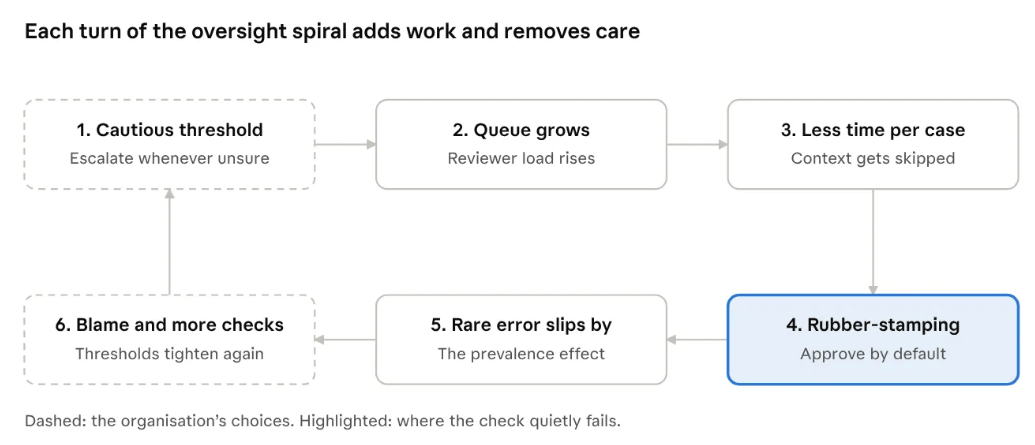
A cautious threshold escalates anything uncertain, so the queue grows and time per case drops. People start to rubber-stamp, and a rare error slips through. The incident review blames the reviewer and adds more checks, which tightens the threshold again.
Better review design costs effort
You might expect better review screens to fix this. They help, at a price. Zana Buçinca’s team at Harvard tested “cognitive forcing” designs, such as making people decide before seeing the AI’s answer, checklists and short waits. They reduced over-reliance on the AI. But people gave the lowest ratings to the designs that worked best, and preferred the easier ones they performed worse with.
Careful review costs effort, and the only way to pay for it is to have fewer reviews. You can have careful approvals or many approvals. Not both.
Where a human should intervene
Two questions decide it. How costly is a mistake, and can it be undone? And does a person add something the system can’t: context outside the data, a values trade-off, discretion, something genuinely new, or a conversation with the person affected?
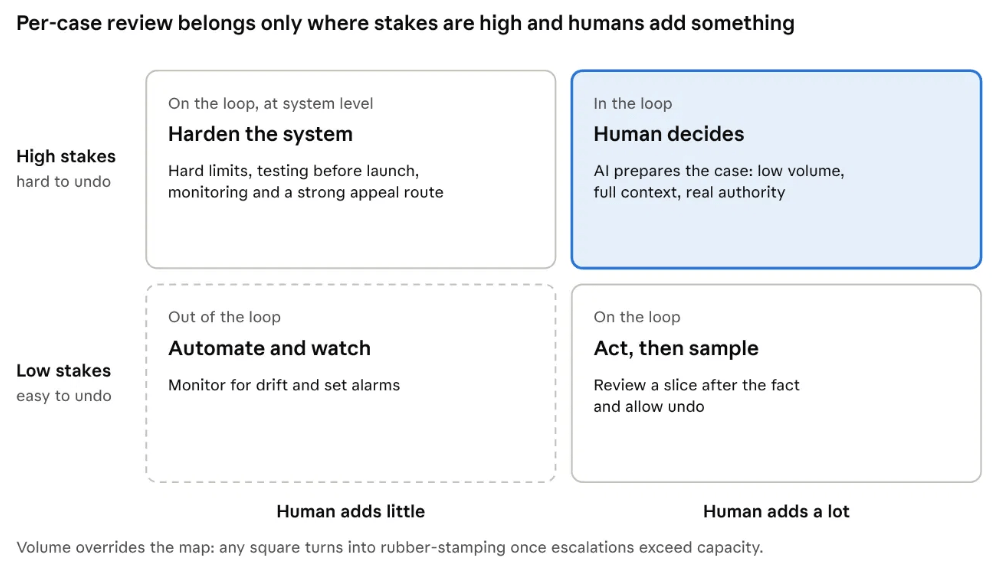
The top-left square is the uncomfortable one. The stakes are high, but a person reviewing each case would add little or end up rubber-stamping. The honest answer there is to harden the system, not to add a reviewer.
Ben Green surveyed 41 policies requiring human oversight and found people were unable to do the oversight those policies assumed. He argues for institutional oversight instead: justify the algorithm and any human oversight with evidence, and put both through public review before adoption.
Controls other than approval
Approval is one control among many, and often not the cheapest.
- Caps and limits: the agent can act up to a set amount on its own.
- Undo windows: act now, and allow reversal for a set period.
- Staged rollout: release to a small slice before everyone.
- Approve the plan, not every step: people engage at that level.
- Sampled review: check a slice of decisions after the fact.
- Circuit breakers: escalate on a pattern of trouble, not every case. Claude Code, for example, drops back to manual approval after repeated blocks.
- A challenge route: the person affected can ask for a human review.
- Approve the rules: people set rules and thresholds, not each case.
If you keep a reviewer, design the role
Sometimes a person in the loop is the right answer. Then design the role, not just the approve button.
- Set a review budget. Cap items per person per day. Treat going over it as a defect in the system, not a staffing problem.
- Escalate with a reason. Say why this case, what is unusual about it and what the system is unsure of. Show evidence for and against, not just a recommendation.
- Make “no” as cheap as “yes”. Ask for the same justification either way, and protect people who slow things down.
- Seed known-bad cases. Airport screening plants test threat images to keep screeners alert. Do the same, and measure how many your reviewers catch.
- Close the loop. Show reviewers what happened after they decided, and let their overrides change the thresholds. A re-analysis of the human–AI studies found better results where people got outcome feedback (i.e., being told the correct response after each case).
- Keep the skill alive. Rotate reviewers through doing the work without the AI.
- Split the five jobs. Don’t stack gatekeeper, signatory and trainer on one person.
- Match accountability to power. No power to change it, no name on it.
Six signs your oversight has become theatre
- Agreement with the system sits in the high 90s.
- Decisions take a few seconds each.
- The catch rate on seeded cases is falling, or has never been measured.
- Escalations keep rising and nobody asks why.
- Incident reviews end with “the reviewer should have caught it”.
- Reviewers can’t say what happens after they click.
If several of these are true, your oversight reassures people without catching much.
The question to ask any team
Who is this review step protecting: the person affected, the organisation, or the reviewer?
If the honest answer is “the organisation”, you have added work without adding safety. You have also given everyone the false comfort that a human is watching.
Try it on one review step in your own service now:
- How many items does one reviewer handle a day?
- How long does a typical decision take?
- What share of cases do they approve?
- What can they see that the system can’t?
- Can they realistically change the outcome?
If agreement is in the high 90s and decisions take seconds, treat it as a warning sign, not a safeguard.
I’m going deeper on this in a free Maven Lightning Lesson on January 5th 2027 at 5pm GMT, with the full map, the evidence and the design moves. Sign up here: Designing Human in the Loop AI that Works