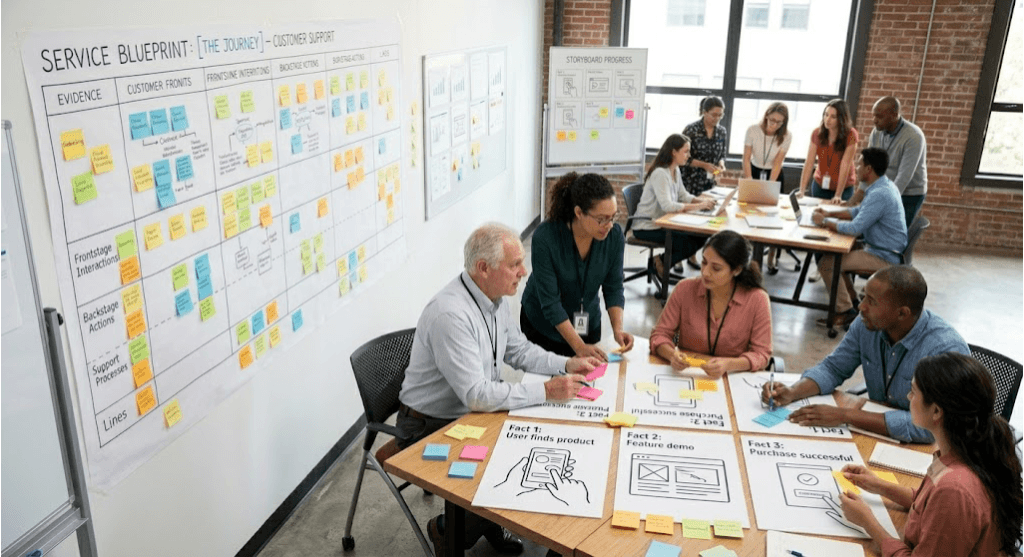
Summary: There is a distinction at the heart of service design that most organisations never fully reckon with. It lurks beneath years of journey mapping workshops, sticky notes, and swim-lane diagrams. It is the difference between mapping how your service works and mapping what it is actually like to use it. Defining or discussing journeys from your organization’s perspective can reduce the power of journey mapping.
Learn more: Attend a 30 min session July 7th (FREE) Journey Mapping as a Strategic Superpower
Journeys You Define vs Journeys Your Users Live
The key issue is, Are you mapping how your service works or how users define and experience their journeys? These are not the same thing. They rarely even resemble each other.
The Confusion Starts With the Word “Journey”
“Journey” has become one of those terms that sounds meaningful and lands nowhere. Used loosely enough, it covers almost anything: a wireframe walkthrough, a touchpoint inventory, a flowchart with emotions bolted on.
But when most organisations say journey, they mean process. Step one, step two, step three. To get this outcome, first do X, then Y. That is a process flow. It describes what the organisation expects people to do. It is system-centred. The organisation is the protagonist, and the user moves through its world.
A true journey starts somewhere else entirely. It starts in a person’s lived experience, before your service appears.
What Process Flow Thinking Actually Maps
Process flow thinking produces questions like: what screens exist, what information is required, what happens next? It traces the user entering the service, completing a form, submitting evidence, receiving an outcome.
Yes, But: It is not all useless. Operational clarity does matter. But it maps the organisation’s logic, not the person’s experience. It tells you how the system flows. It does not tell you what it costs someone to move through it. This is where Richard Pope in the book Platformland suggests we move beyond ‘user needs’ into also considering ‘administrative burden’ in public sector service design contexts.
What Journey Thinking Actually Requires
Journey thinking starts with a user’s day, not the transaction. What was happening when this issue surfaced? Why now? What pressures already exist? What other responsibilities compete for the same attention, energy, and time?
It asks about emotion, about previous experience, about what someone already believes will happen before they touch anything you’ve built. The service does not appear at the start of this story. It enters partway through a life already in motion.
That is the structural difference. Process flow puts the user inside the organisation’s world. Journey thinking puts the service inside the user’s world. Outside-In design vs Inside-Out design.
The Map That Looks Right But Isn’t
Consider a council benefits journey mapped conventionally: resident discovers benefit, resident applies, council reviews, benefit awarded. Reasonable on paper. Makes sense to express policy direction. Even politically safe to present.
Now consider what a lived experience lens might actually reveal about the person making that application. Single parent. Three jobs. Caring responsibilities alongside paid work. Debt letters arriving regularly. Limited literacy. Deep anxiety about government systems built from previous rejection. Too exhausted to fill in 75 pages online. Need to print, but no access to a printer.
Inside that reality, the application form is not the story. It is one small moment inside a much larger weight. The map that stops at the form has not mapped an experience. It has mapped a transaction and called it a journey.
Service Design’s Recurring Weak Spot
Many journey maps are process maps with better typography. Using AI to generate them or inputs for them won’t help if don’t prompt with the right distinctions. Ditto for getting help with personas.
Worse, most journey maps confuse touchpoints with channels, while focus on the transactions. Again, transactions are real and worth documenting. But they routinely miss the surrounding context: daily life, social relationships, power dynamics, disability impacts, cultural pressures, financial strain, competing demands on time and cognitive load.
The result is a map of the service. Not a map of the experience.
This is not a minor methodological quibble. It is the difference between a team that understands who they are designing for and a team that has described what they built.
The Methods That Close the Gap
Genuine journey understanding tends to come from methods that follow people rather than interview them about systems. Rapid Ethnography is the gold standard (also called Day-in-the-life studies, Contextual inquiry, Shadowing, Participatory research or Diary studies).
Evidence from the field brings the lived experience lens to life.
These approaches are slower and harder to schedule than a workshop. They are also qualitatively different in what they return. They surface everything the organisation cannot see from inside its own processes: the workarounds, the silences, the moments of shame, the decisions made before anyone reaches a first screen.
A well-facilitated workshop in service design can produce a plausible map quickly.
Bottom line
Bring clarity to conversations that use the term ‘journey’. Be aware of who’s perspective is being represented in a customer journey decision.
- Process flow asks: how does someone move through our service?
- Journey asks: how does our service appear within someone’s life?
The first is organisation-driven. The second is user-driven. The first maps transactions. The second maps reality.
That gap is where service design either becomes genuinely transformational or simply produces prettier process diagrams. Organisations that mistake one for the other will improve the wrong things, measure the wrong outcomes, and wonder why the service still frustrates the people it was built to help.
The fix is not a better template. It is a more honest question: whose world is this map centred on?
If the answer is describing the service, start again.
Go Deeper: Attend (FREE) July 7th 2026 Journey Mapping as a Strategic Superpower
Join my Journey Mapping Deep Dive Lab (July 14th) where we’ll go hands-on mapping Neurodiversity in “3D” (Backward journeys, Current and Future journeys).
Frank Spillers is a service design lead and founder of UX Inner Circle. More bio info below.