Summary: If you do accessibility work or talks, stop treating Microsoft’s “temporary disability” as a kind of disability. Microsoft Inclusive Design’s “temporary or situational disabilities” are not legal disabilities. A broken wrist ends; systemic access barriers don’t. Worse, by assuming the disability types are similar, you lose the ability to properly advocate for users with disabilities who are systemically blocked by access barriers.
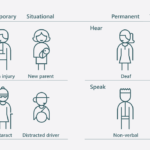
Almost every inclusive design talk I’ve seen lately has the same slide. Three columns explaining the ‘spectrum of disability’: permanent, temporary, situational. Someone with one arm, someone with an arm in a cast, a new parent holding a baby.
It’s a compelling slide, and it has helped a lot of teams take inclusive design seriously. But the distinctions of “temporary or situational disability”, are doing quiet harm. It’s time to drop them.
See: The problem with Inclusive Design and Temporary Disabilities
A broken wrist is a brief or extended period of inconvenience. It can be genuinely humbling. But it is not the same as systemic access barriers that touch every area of your life and don’t go away. When we put the two on the same line, we shrink disability down to a short-term task problem. Then we design, research and make the business case on that basis. That gives us a watered down approach to disability advocacy.
What the spectrum got right
The persona spectrum comes from Microsoft’s Inclusive Design toolkit. Its core idea is sound: disability happens where a person and a designed thing don’t fit. Design for that mismatch, and the fix often helps far more people than you started with. Microsoft’s shorthand for this is “solve for one, extend to many.”
That framing did useful work. It moved designers away from the medical model, where disability is a fault in the person. It also gave teams a business case that product owners could say yes to.
So the problem isn’t the mismatch idea. The problem is what happens when “temporary” and “situational” get treated as kinds of disability, instead of as evidence of who else benefits.
Reset this: drop ‘situational and temporary disabilities’ from your focus, and you’ll be able to understand the nuance and critical needs of those with permanent disabilities.
Inconvenience is not the same as exclusion
A temporary injury limits some tasks for a while. Disability means barriers that stack up across work, money, housing, healthcare and public services, year after year. Put side by side, they are not two points on one spectrum.
| Arm in a cast | Disability | |
|---|---|---|
| How long it lasts | Weeks or months, with an end date you can see | 12 months or more, often for life, and may come and go |
| Where the barriers are | A handful of tasks: typing, carrying, opening jars | Work, money, housing, healthcare, transport, public services |
| Your skills | Beginner: no adapted routines, no assistive tech | Often expert: adapted routines, assistive tech, workarounds |
| Work | Time off, job usually held open | Far less likely to be in work |
| Money | Some short-term costs | Higher living costs and higher poverty rates |
| Systems to deal with | A doctor or maybe a physio | Benefit assessments, repeated evidence requests, negotiating adjustments, social care |
| How others respond | Mostly sympathy | Often doubt or disbelief |
| Legal status | Usually not a disability under the Equality Act | Protected under the Equality Act 2010, ADA, EU Accessibility Act |
The same pattern in the UK, US and EU
Across all three, disabled people are far less likely to be in work and far more likely to be poor. The employment gap alone runs from 24 to almost 37 percentage points.
| Disabled people in work | Non-disabled people in work | Employment gap | Money | |
|---|---|---|---|---|
| UK | 52.8% | 82.5% | 29.7 points | £1,095 a month in extra living costs on average |
| US | 38.1% | 74.8% | 36.7 points | 20.9% in poverty, vs 8.6% of non-disabled adults |
| EU | About half | About three in four | 24.0 points | 28.8% at risk of poverty or social exclusion, vs 17.9% |
Definitions, age bands and years differ, so compare the pattern rather than the decimals. UK: ages 16–64, April to June 2025 (DWP), with extra costs from Scope. US: employment–population ratios for ages 16–64 in 2025 (BLS); poverty is ages 18–64 in 2024, from Census Bureau figures reported by UC Davis. EU: employment for ages 20–64 in 2024 (Eurostat, European Commission); poverty is ages 16 and over in 2024 (Eurostat).
In the UK, the gap isn’t only about getting a job. Disabled workers leave work at more than twice the rate of non-disabled workers (10.1% vs 4.6% a year). Disabled people out of work move into a job at around a quarter of the rate (7.6% vs 28.3%). That is what systemic looks like: the barriers persist, and they compound.
Five ways the distinction does damage
1. It teaches the wrong lesson
Someone with a broken wrist lives through the beginner stage of impairment. They have no adapted routines, no assistive tech skills and no disabled community to learn from. In practice, it works like a disability simulation.
Yes, But: Simulations backfire. In a 2015 study by Silverman, Gwinn and Van Boven, people who simulated blindness then judged blind people as less capable of working and living independently. Silverman, who is blind, has pointed out that much of the disability she experiences comes from badly designed environments, such as inaccessible websites, not from her sight. Teams come away believing disability means struggling with tasks, when it mostly means meeting barriers.
2. It puts non-disabled people back at the center
The spectrum’s business case is “this helps millions more people.” That works in a budget meeting. But it implies disabled people’s needs only count once they overlap with what’s convenient for the majority. Accessibility shouldn’t need a non-disabled beneficiary to be worth doing.
3. It leaks into research
The temporary column makes it easy to recruit a colleague with a sprained wrist, or run a one-handed test, and call it inclusive user research. That cuts out the people with the most relevant expertise: disabled people who use assistive tech and work around barriers every day. “Nothing about us without us” has no temporary exception.
4. It misses the journey
A broken arm is mostly an interface problem: Can I tap this button?; Can I carry this bag? Disability is a service problem. It’s the government disability allowance assessment, the phone-only booking line, the third request for the same evidence, and the adjustment you have to negotiate again with every new manager.
Those barriers build up across the accessibility end-to-end journey and across different services. You won’t find them by testing one screen with one hand.
5. It doesn’t match the law
Under accessibility legislation (ADA, EU Accessibility Act, the Equality Act 2010), disability means an impairment with a substantial and long-term effect on day-to-day activities. Long-term means it has lasted, or is likely to last, at least 12 months. The EHRC’s code of practice gives a broken limb that should heal within a year as an example of an effect that is not long-term. Calling it a disability blurs a line that organizations are legally accountable to.
What to keep, and what to call it
Keep the mismatch idea. Designing for a specific exclusion and finding the fix helps others too is real, and it’s a useful argument. Just stop calling the second group disabled.
A cleaner way to frame it:
- Disabled people are who you design with and for. They take part in the research and set the bar.
- Short-term limitations (an injury, recovery from surgery) and situational limitations (bright sunlight, a noisy room, one hand busy) are evidence of who else benefits.
The spectrum can stay as an argument about reach. It can’t be a stand-in for disabled users, a recruitment shortcut or an empathy exercise.
Don’t throw out fluctuating conditions with it
Dropping “temporary” must not mean dropping conditions that come and go. MS, long COVID, chronic pain, ME/CFS and many mental health conditions are not temporary. But they don’t look constant either, so they are often missed or disbelieved.
The law already allows for this. The EHRC’s code treats an effect that stops as continuing if it is likely to come back. UK Dept. of Work and Pensions data also shows how fluid disability status is: nearly one in three people classed as disabled one year were no longer classed that way the next.
So duration on its own isn’t the test. The real question is whether someone faces barriers that are structural and that compound over time, not whether their symptoms are visible today.
What to do instead
- Redraw the slide. Put disabled people at the centre. Show short-term and situational limitations as a wider circle of people who also benefit.
- Recruit disabled participants. Budget for it, pay people properly and ask about access needs in screening. Don’t count injured colleagues or one-handed tests as inclusive research.
- Drop simulation exercises. If teams need to understand disability, have them watch disabled people use assistive tech. Better still, pay disabled people to run the session.
- Map the whole journey. Look for barriers across channels and services: assessments, evidence, appointments, phone lines, letters. That’s where exclusion builds up.
- Watch the language. Say “short-term injury” or “situational limitation”. Keep “disability” for disability.
The slide was a starting point
The persona spectrum got a lot of teams into the room, and that was worth doing. But a decade on, the temporary column does more to dilute disability than to include disabled people.
A broken wrist is humbling, and then it ends. The barriers disabled people face don’t end when the cast comes off. Our methods shouldn’t pretend they do.
Learn more
- Watch (Free 30 min) Taking Accessibility Wider with End-to-End Journeys
- Watch (Free 30 min) Beyond User Advocacy: How to Advocate for Disabled Users