
Summary: C-SAT (Customer Satisfaction rating) is broken. Yet we rely on it. Yes, but how, when and why you ask for feedback is critical. Most CSAT scores are disconnected from the customer’s goal, journey stage and eventual outcome. Moreover, how you use feedback as a product or service level data point is critical to tactical and strategic decision-making. C-SAT often lacks context, and capturing it at contextually specific moments, understanding those moments and then adjusting their potency is key. Generative AI offers a useful model: feedback becomes valuable when it enters a measurable improvement loop.
Why Customer Feedback Sucks
Customer feedback is like the ‘listening post’ that listens with one ear, and ignores the customer journey. Feedback is precious, don’t get me wrong. “All feedback is good” right? ‘There’s no such thing as bad feedback’ is something I’ve believed my whole life.
Feedback matters as noted from this seemingly dated but highly relevant finding:
“Customer service organisations have the power to drive positive brand sentiment in several ways. For example, 77% of customers have a more favourable view of brands that ask for and accept customer feedback. And 68% of customers have a more favourable view of brands that offer or contact them with proactive customer service notifications”.-Microsoft State of Global Customer Service report (2017)
However, when your call center asks for feedback after a call, and you’re in the middle of the resolution journey, for example, what good is that? There’s no “get back to me in two weeks once the resolution is supposed to be complete”. I’ve experience many sweet promises (5 stars) that never manifested (1 star). In short, feedback if captured at the wrong time, in the wrong way, and against the wrong metrics is misleading and imprecise.
Journey-level and precision touchpoint specific (context-specific) metrics are rare. But they matter more than ever. Users have journeys across a myriad of complex channel and touchpoint specific interactions. This isn’t 1983. It’s dated to use C-SAT as if the world is static, when it’s dynamic as hell.
Why this matters: Getting feedback when and where it happened (touchpoint specific) but also calculating for time delays (a journey perspective) is critical to improving product-service experiences.
- A couple of bad examples: After six week’s a text message proclaims “We noticed you’re no longer with us, can you give us some feedback?”. This is after feedback has been poured out across TrustPilot, email and a senior manager in charge of feedback has intervened and apologized profusely.
- My all time favorite from Microsoft Outlook: “Enjoying Outlook so far?” Yes, No. No goes to “Get Support”. No feedback gathered. Is this why Outlook hasn’t evolved over 20 years?
- Good examples: Emerging AI platforms. Not that product, but what AI does with feedback is critical to improving your feedback to experience improvement loops.
AI Shows the Power of Feedback in Experiences
When ChatGPT launched, users could rate each response. This was not decorative. It gave OpenAI precise evidence about helpful and unhelpful answers. Reviewed feedback could then support evaluation and model improvement, including reinforcement learning from human feedback (RLHF).
Why RLHF matters to AI: It teaches models using patterns in human preferences. A thumbs-up or correction provides evidence about those preferences. But, like C-SAT as it’s currently gathered: a Chatbot thumb in only a basic signal. It does not automatically train the model or identify the problem.
Feedback across AI experiences:
| Experience | Useful feedback |
|---|---|
| Chatbot | Ratings, corrections, repeated questions, escalation |
| Copilot | Accepted suggestions, edits, reversals, task completion |
| AI search | Result selection, follow-up searches, source checking |
| Agent | Confirmation, intervention, undo, action outcome |
| Recommendation system | Selection, rejection, later satisfaction |
Feedback becomes especially important when AI can take actions. The system must detect mistakes before they spread.
In the same way, we should think about customer experience or user experience based feedback in a similar way. That is: contextually-relevant to the user, as they go through their experience.
In GenAI systems, thumbs turn guesses into signals.
- Preference signal: Did the response help?
- Correction signal: What was wrong or missing?
- Behavioral signal: Did the user edit, retry or leave?
- Outcome signal: Was the task successfully completed?
- Trend signal: Are failures increasing over time?
Feedback closes the loop
A simple feedback loop has four stages that we can model for all customer C-SAT feedback:
- The AI produces an answer or action.
- The user responds to the result (missing across non-AI channels).
- The team identifies what worked or failed.
- The experience, instructions, or model improves (questionable if reports are generated or experiences are actually actioned on and improved across channels or journeys).
Today, in multi-channel experiences (excluding AI) we see breaks in this loop. The same problems keep re-occuring in an experience or journey. That’s why when you give detailed customer feedback, you can come back 3 or 6 months later (or 1-2 years) and the exact same broken UI, non-accessible button or confusing policy persists.
How to improve your feedback loop
- The product or service creates an experience.
- Feedback is captured at a meaningful moment.
- The team connects it to context and outcomes.
- Someone becomes responsible for responding.
- The improvement is delivered and measured.
- The customer is updated where appropriate.
Most feedback systems break between steps three and five. Feedback gets reported without producing visible change. Underlying this is a maturity issue. Where does your org or team fall on the scale?
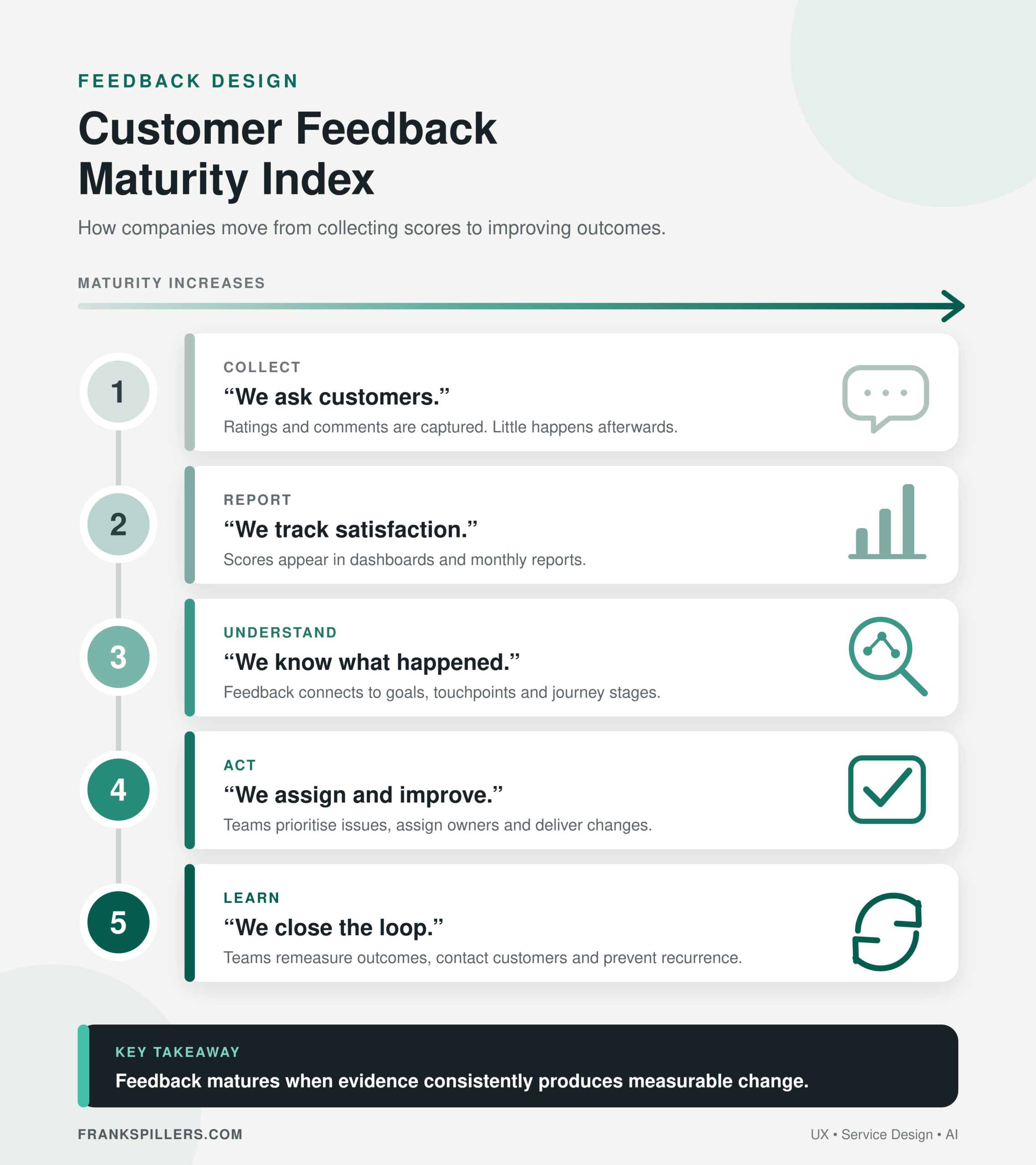
A quick maturity test
Ask five questions:
- Do we know where feedback occurred?
- Do we understand the customer’s goal?
- Does each issue have an owner?
- Can we show what changed?
- Did we measure whether it worked?
Score one point for each yes:
- 0-1: Collecting
- 2: Reporting
- 3: Understanding
- 4: Acting
- 5: Learning
Establishing feedback design principles
Developing feedback design principles can help refocus the power and purpose of feedback:
- Feedback must lead to visible action.
Many systems capture feedback without connecting it to change. Insights may remain within Marketing, Communications or reporting teams. Meanwhile, UX, CX, product and operational teams lack clear access or ownership. Closing the loop means reviewing feedback, assigning responsibility, making changes and showing users what happened. - Feedback must capture context.
A rating without context provides a weak signal. Useful feedback identifies the user’s goal, journey stage, channel, circumstances and expected outcome. The collection method should also let people describe the experience in their own terms. Poorly timed or imprecise questions create noise. - Feedback depth should match the consequence.
Low-risk content may only need a rating and optional comment. High-consequence decisions require explanations, confirmation, monitoring, escalation and human review. The greater the potential harm, the stronger the feedback and recovery mechanisms must be. - Complex journeys require richer feedback.
A single rating cannot explain an experience spanning channels, teams and time. These journeys need methods such as interviews, diary studies, journey reconstruction and follow-up conversations. The aim is to understand how separate interactions combine into one experience.
Key takeaway: A C-SAT score measures a reaction. But a feedback system explains what happened, connects it to the customer journey and gives someone responsibility for improving it. Feedback only creates value when it closes the loop for the customer.
Learn: Starting November 2026, I’m teaching AI-First UX & Service Design 101 & Certification- Design for LLM & Agents